Wednesday, 23 March 2016

Aftermath of National Economic Council Retreat - Silver lining for the Agriculture Sector in Nigeria

After years of advocating for the full development of Nigeria Agric Value Chain and also the implementation of an international food safety standard in the value chain, I was relieved yesterday when I read the highlights of the just concluded National Economic Council Retreat.
President M. Buhari


The 2-days NEC retreat which was concluded on Tuesday 22 March, 2016 ended with a number of agreements in 7 Thematic areas including Agriculture. These are meant to be the guidelines as to where government is looking to invest, develop and areas where private investors should also be focusing on.

Below are the highlights of what was agreed for the agriculture sector. In the coming days we will break them down and discuss what this means for Nigeria and how anyone interested in exploiting the Agriculture value chain can benefit.

Like I always say there is more to agriculture than farming and there seem to be government will to develop this industry now.

Highlights of Agriculture plans from the NEC Retreat
  1. The Federal Government to re-position Bank of Agriculture to enhance its capacity to finance agriculture.
  2. Funding for Agricultural sector is considered critical and sources of intervention funding from the Central Bank of Nigeria should be considered
  3. A single digit interest rate for agricultural loans should be considered while duties and taxes for Agricultural products and equipment should be waived
  4. Develop strategic partnerships between Federal and State government. Each State should make specific commitments to crops in which it has comparative advantage and request Federal Government intervention
  5. National targets for self-sufficiency should be set for identified crops, which should be monitored. Tomato paste – 2016, Rice – 2018, Wheat – 2019
  6. The Federal and State Governments should roll out agricultural extension services nationwide
  7. The Commodity Exchanges should be established for price regulation and avoidance of losses due to lack of markets. The Abuja Commodity Exchange should be revitalised
  8. The National Agricultural Land Development Authority (NALDA) should be re-established
  9. Federal Government should develop an Agriculture Implementation plan whereby State Governments are encouraged to identify at least two crops in which they have comparative advantage
  10. States should open up of rural/feeder roads to facilitate transportation of agricultural produce to be supported by the Federal Government
  11. The Federal and State Governments should establish minimum price guarantee for farm produce
  12. The Federal Government should provide immediate funding to upscale efforts of Agricultural Institutes of Research and Development across Nigeria
  13. State Governments should also be encouraged to fund research and development in agriculture through technical colleges, universities and research institutions
Mr. Audu Ogbeh - Hon. Min. of Agric
The Minister of Agric, Mr. Audu Ogbeh also gave me something to cheer about yesterday. During an interview with Channels TV news on Tuesday March 22, 2016 he talked briefly about government plans in banning the importation of tomato paste and other products which he said had been certified unfit for consumption by the United Nations and National Agency for Food and Drug Administration and Control.

He also said that while Nigeria is aiming for food sufficiency amidst importation challenges, a major concern is the large scale self-poisoning by Nigerians. This has to do we what is used to preserve food and how food is packaged for sale amongst other poisonous practices. The Minister was with members of the Food and Agriculture Organisation who were in Nigeria to help implement a food safety policy that would strengthen food control system through an institutional reform when he gave this interview.

For me, this is the icing on the cake. There is no talk of food sufficiency without solving the health and safety problems we have in the value chain. This also feeds into the export plans for Nigeria, without fully implemented food safety initiatives we cannot export anything.

I will be following up on this personally.

Tuesday, 10 March 2015

MAKOKO FISH MARKET - Sharks, Stingray and all the lovely sea creatures


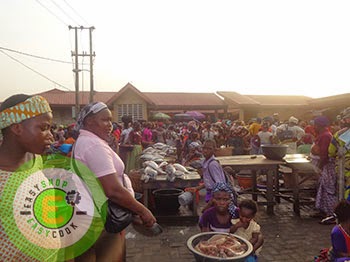
Makoko Fish market - ASEJERE SMOKING FISH MARKET (Asejere means Trade with profit) is located at Yaba; it is a popular market off Herbert Macaulay Street, Yaba. It is a busy and I think one of the longest streets in Lagos; which leads to the 3rd Mainland Bridge.

Makoko Market Entrance
At the office in www.easyshopeasycook.com , we come here between 2 - 4 times a week. The fish market opens every day but you get the best prices early in the morning on Tuesdays and Wednesdays that is why our Fresh Fish days at the office are on these two days. Monday is rather dry, Thursday - Saturday are for caterers that come to buy fish for weddings and parties. Knowing that fish is a well sort after dish at high profile parties the fishmongers increase their prices on these days because the caterers have no choice but to buy.
Fresh Asa or Osan Fish for weddings


Makoko Market Entrance
Makoko market is not by any standard a high profile fish market; the food safety standard here is …. In fact there is no food safety standard here except the regular cleaning of tables and sweeping of the floors. There is no rhythm and no rhyme, there is no particular structure in place but I get the feeling that somehow everyone knows their stall when the sun rises. Getting the traders here to wear aprons, gloves and caps will be a huge task but this is not my mission here today. I will look away from all the dirt and enjoy the beautiful creatures God put in the sea for us to eat, use as ornaments or just viewing pleasure.
Mothers and little kids all involved
The Market is dominated by Agoyin people from Cotonou. They are mostly fisher men's wives and children and they live around Makoko. Some within walking distance of the market while others use the canoe to and from their homes daily.

I sometimes buy fresh fish from Oyingbo market nearby and see some of my fishmonger friends there as well. Most trade at Makoko early in the morning and by noon go off to Oyingbo market to finish off leftovers from the morning sales.

Baby shark, Large Baracuda Fish, Crocker, Sole Fish
This Tuesday morning at Makoko, the fish was very pricey. This is because for some reason the fisher men could not catch a lot of fish. The fishermen at Epe who sometimes supply this market as well were also not successful so the little catch of the day were sold at cut throat prices. One of the women said to me  ' everything has gone up, even the dollar'; I don’t know how the exchange rate affects the fish caught in Lagos waters by local fishermen but their wives are using that as an excuse to increase their prices in the market…. Nigeria!, we allow all sorts. But then again they are from Cotonou; which means whatever profit they make, a portion will be sent to their relatives at home and this is where I think the exchange rate comes to play. This is my layman explanation for sanity sake and it makes sense. hehehe

Lady fish - beautiful but looks bony. I prefer flesh
Lobster once for prisoners now for Kings, imagine that.
I always enjoy coming here; I would bring my two girls here during the next holiday as they are old enough to enjoy the sights and sounds. Like me, shopping is in their blood but I have to get ready for millions of questions especially from the younger one. You will find all sorts of fishes here; I spotted a baby shark today and lots of fishes that I often see on the National Geographic Channel like the famous Stingray that killed the popular Crocodile Hunter Steve Irwin. I can’t imagine eating that fish; probably because a similar one killed Steve Irwin and the thought turns me off completely and also because my palate is not so rich so trying new things can be very difficult.
Calamari... it tastes like prawns. I like this.

I spotted Calamari, Tiger Prawns, Shrimps, Crocker Fish, Red and Black Snapper, Baracuda, Catfish, Sea Crab, Sea Snails, Tilapia and so many that I have no idea what the English names are. When I ask the fishmongers they give me the Cotonou names and they sound so complicated I don't bother to retain it in my memory… hehehe.

Not all the women here sell fish, some wait in line to help clean the fish at the back of one of the bungalows in the compound near the smoking kiln. The smoking kiln is operated by the women; in fact I do not remember seeing any male in this market except the little boys and the men at the gate collecting parking fees.

Stingray - Steve Irwin made this popular.
The smoking area is where the deep freezers are also housed. The fishes are brought in fresh everyday and by end of the day they store the dead fishes in the freezer or smoke it in the kiln.

Smoking Kiln, the women are also in charge.
There are so many children and babies in this market. School is definitely not in the agenda. They are waiting to take over from their mothers or better still start their own business doing this same thing. There are some fishmongers here that I have known since they were just kids 10 years ago and now they own their own fish, prawn or crab basket. I enjoy patronizing those kids whenever I see them as I watched them grow. Some are married with little kids as well and the cycle continues. They are sometimes more aggressive than their parents and they drive a hard bargain too but all in all it is beautiful knowing their story.
Back room cleaning women

So this is my journey today, I will visit the Epe fish market soon and fill you in on the sights and sounds. I am from Epe, the fish market is just down the road from my family house but it is not somewhere I go frequently as it too far from my office; which will make the fish too expensive to sell to my customers.

 Hope you enjoyed the pictures.

Cheers,
@lagosshopping | @EasyshopLtd

Sea Crab, beautiful and delicious if someone takes out the meat for me
Cleaning the table for today's sales
Waiting for customers. Cotonou Fishmongers

Wednesday, 3 December 2014

#AgriBiz4Dummies - Vol. 1 GOING BACK TO THE ROOTS


 Technology required to fabricate efficient farm tools

Crude oil is the new enemy of the planet. Whether it is through its use or by its trade every country is looking for a way to do without it.Technology and Agriculture are the two industries that can profitably fill the economic gap that will be created if oil dependent countries diversify.  

Agriculture is about food cultivation and everything that is directly or indirectly related to it. Agribusiness is the commercialization of agriculture especially using technology.

My interest in Agribusiness emanates from my business of retailing fresh farm produce on my company's website www.easyshopeasycook.com . Our need for traceability, freshness, quality and cost reduction lead us to backward integration; which is a business model whereby a company takes direct control of how its products are supplied. In our own case we need to have direct control or influence in the farms that supply our company in order to trace the produce, eliminate adulteration, enforce food safety policies, improve profit margins and make our company more competitive.
We need more local research Institutes to improve our seeds
The more I got involved in the process the more I realized I knew very little about it. I got involved with some farm produce associations and I found out we all know so little hence the dearth our country is in. So this series is for me to learn about the business of agriculture, share with others and learn from the feedback I receive from everyone.

I have called it #AgriBiz4Dummies because I plan to be as simple as possible to remove the complication hindering people from getting involved to help build the industry. 

The business of Agrochemicals
Agribusiness includes agrochemicals, breeding, crop production, distribution, farm machinery, processing, seed supply, marketing, retail sales as well as the education and technology behind all these. My interest is not really in the academic but the practical things being done around the world in this sector. I will highlight what Nigeria and Africa are doing and what more we must do to meet up and possibly dominate this sector globally.

Greenhouse technology and materials
China has been equated to Manufacturing; I strongly believe Agribusiness is ours to take. Africa should be the food basket of the world because the land, the climate and the people are available here, all we need now is the technology and will to back it up. 

I hope to hear from you here or tweet me @lagosshopping, it becomes more interesting that way.

Cheers.


Tuesday, 18 November 2014

So called sorted fresh tomatoes and other ugly market practices.

There is an urgent need to enforce basic food safety initiatives in our market place. We cannot continue to be cheated by market agents and middle men. They are so powerful that it is difficult to influence their method of operation in Mile 12 market especially.

Fresh produce come in from various parts of the Nigeria in rafia baskets. This means by the time they get to the market half are rotten and broken because of the mode of transport. Sometimes you find that some farm workers slept on the produce all through the ride from the farm. There are no standard baskets or standard weights. The produce are claimed to be both sorted and unsorted, to me there is hardly a difference in the two categories.Whichever you decide to buy you will still have to sort out yourself before use.

If you buy the sorted tomatoes I guarantee you about 30% will be either broken or rotten. Imagine what you will find in the unsorted basket. This is very very frustrating for me as a retailer. It is difficult to plan, you are not sure of the quality you can get any day and also the weight is not fixed as baskets can be changed at will. You are not even sure of source of the produce as there is no form of traceability tag available. We shop blind daily. The worst thing is the awful smell you get in the market. Fresh produce are supposed to smell fresh but not our own.... very nauseating I tell you.

That is why at Easyshop we have decided to partner with the farmers directly. This way we are sure of the origin of the produce, the method of farming, the size of the basket and most importantly the quality to be supplied to our office. It also helps us to control our prices.

'Sorted' Tomatoes directly from the market
Middle contents of the 'Sorted' basket of tomatoes


Bottom of the basket of 'sorted' tomatoes

Some broken tomatoes in the 'sorted' basket of tomatoes
At Mile 12, price is determined by various forces even the mood of the men in charge. The association can decide to fix a price based on demand or political situation at the moment and this will destabilize our operations in the office. Sometimes the agents will decide not to sell the fresh produce on the truck because the old stock is still on ground even if the old stock is obviously rotten. Then you have a case of the traders stuffing the rotten lot at the base of the basket and then the fresh ones on top. All sort of ugly practice that cannot be explained.

If the market is accessible and car park is sufficient I doubt they will have a problem of selling fresh produce in record time. But the market agents themselves have blocked the car parks with stalls and frustrated the very customers they crave.Someone needs to tell them a market place does not need to be dirty or cramped to be vibrant. Must we accommodate all manners of traders? If you cannot adhere to the rules of the market place why should we drop our standards? Whose job is it to make sure the fresh produce brought in are fresh and not rotten farm produce that are forced into our hands?

Is this the job of LGA's or State govt or even Federal? We are throwing away a lot of money and food in the midst of starving people. We are also allowing ugly market practices that are harming our health and economy.

Government is spending a lot of money to help farmers and increase farm produce; there is more to farming than just growing crops and fertilizer. Without proper food safety practice enforced in the supply chain the impact will not be felt by the final consumer. What use is farming, if you cannot sell your produce.

Wednesday, 16 July 2014

THE RISING PRICE OF TOMATOES – IT’S THE GOLD SEASON


Fresh ripe tomatoes

“Nigeria is one of the largest consumer of tomato in the world” that has been said by various analyst world over. I don’t need an analyst to tell me that because I know that in Nigeria we eat just about everything with tomato. All our stews, soups and sauces in every corner of Nigeria includes tomato.

 We use tomatoes for salads, to fry omelettes, sandwiches and various other dishes. If you are like my husband or my father, you also eat tomato raw (yuk) like you eat an apple or any fruit.

Tomatoes can be cultivated anywhere across Nigeria, and this is because our tropical condition is favourable to the survival of tomatoes. There are many varieties of tomato but the greater part of tomato production in Nigeria is undertaken in the North of the country. Kaduna, Kano, Jigawa, Katsina, Sokoto, Plateau and Bauchi states. Although the Southern states also grow commercial quantity the variety grown is not as dry or large as that of the North.

Tomatoes as sold in Mile 12 Market, Lagos
In Lagos, most of our tomatoes and other fresh farm produce are supplied by the North. All the items are transported by road in cane baskets stacked on each other, by the time the produce gets to the market half of it is rotten.

From the farm an average basket can cost about N300 by the time it gets to Mile 12 market it can sell from about N3000 to N20,000 depending on the season and that includes the rotten, ungraded pieces.

Early this year, a basket of tomato in Lagos was sold for about N3,000; today in July we bought the same basket for N15,000. Last week it was N20,000.
There are two major reasons for the increase in price, 1. The season, 2. The unrest in the North.

Regardless of these reasons, we need to find a way to preserve our tomatoes. It is ridiculous to buy a basket of tomato about 40kg for N3000 then 6 months later that same tomato is sold for N20,000. When I know that two thirds of the tomatoes from the farm go to waste because of poor standards of harvesting, storage, transportation and preservation.

Nigeria produces 1.5 million tons of tomatoes annually of which about 900,000 tons rot, Agriculture Minister Akinwunmi Adesina said at a June 13 presentation in the capital, Abuja in 2013.
Nigeria is one of the biggest importers of tomato paste. We import tomato paste from Europe, Canada and China. Yet our own tomato belt is filled with rotten tomatoes. Ludicrous!

Imported Canned Tomatoes - Soon to be produced in Nigeria
In 2013, the Central Bank and Africa’s richest man, Aliko Dangote, teamed up to establish a $25 million tomato-paste factory in Kano. The intervention by the Central Bank of Nigeria, which commissioned a study to show that processing local tomatoes is cheaper than importing paste from China, is part of the government’s drive to cut annual food imports of more than $10 billion. 

I am happy with this huge investment in tomato preservation in Nigeria but my worry is if the factory will cater to local consumption or exports. The factory has a capacity of about 400,000 tonnes of tomato-paste annually for a market demand of 900,000 tonnes annually.
In another news, I read that Thomas Canning of Maidstone, Ontario Canada, has signed a $25-million tomato product deal with a Nigerian company, Festrut Group. The tomatoes will be grown in Leamington, Ontario, the tomato capital of Canada, and canned in nearby Maidstone, before being shipped overseas to Nigeria. 

So as one rich man is helping local farmers preserve, maximize their profit and also feed Nigerians, another rich man is spending the same amount of money to help foreign farmers, save their jobs and feed Nigerians in the process. ummm Issokay… 

I’m in support of preserving local produce and drastically reducing price of local fresh farm produce in the market place. At a period like this when the price of tomato is like that of gold, my retail customers prefer imported canned whole tomatoes. The wholesale customers like Hotels, Restaurants and Eateries have no choice but to buy the fresh tomatoes but this drastically cuts into their profit as they can’t be expected to change their selling prices seasonally.

Diced Bottled Tomatoes - Another form of preservation
It is very sad because I know that if Nigerians can preserve the tomatoes during the season when it is cheap either canned whole or paste we would drop our domestic consumption price by more than half and that applies to many of our fresh foods especially during off season. This will also reduce our dependence on imports. We can do this successfully without resulting in banning. (I do not like banning of any sort, I’d rather we improve our local practices to meet up with our foreign competitors).

Investing in various fresh food preservation methods is a good way to help everyone save money; it is also a good way to help our local farmers maximize their profit and reduce their farm waste. In a country where the poor are over 70% of the population this has to be number one on any transformation agenda.